Key points
- WHS laws apply to a home workplace just as they do to an office, and the duty still applies when the worker requested the arrangement.
- If you cannot meet your WHS duties for a particular worker or task, you must not require or agree to working from home, and you must provide somewhere else safe to work.
- Use the Safe Work Australia checklist as a sign-off step before the arrangement starts, and set a review date.
- Psychosocial hazards such as isolation, being always on and online abuse belong in the assessment, not just the chair and desk.
- A flexible work request under the Fair Work Act and your WHS duty are separate tests, so run both.
What are your working from home WHS obligations?
Under section 19 of the model Work Health and Safety Act, a person conducting a business or undertaking (PCBU) must ensure, so far as is reasonably practicable, the health and safety of workers while they are at work in the business. Section 8 defines a workplace as a place where work is carried out for a business or undertaking, so a worker's spare room or kitchen table becomes a workplace while they are working there, and your working from home WHS obligations follow them home.
Safe Work Australia's information sheet for PCBUs says WHS laws apply to home workplaces just as they do to traditional workplaces such as offices, and that your duties apply even if workers request to work from home or are working from home because of external factors such as severe weather. Workers have duties too: under section 28 they must take reasonable care for their own health and safety, follow reasonable instructions and cooperate with your WHS policies. These section numbers are from the model WHS laws. Safe Work Australia notes that Victoria is the only jurisdiction that has not implemented the model WHS laws and has its own Occupational Health and Safety Act 2004, so Victorian employers should check the equivalent Victorian provisions.
When should an employer refuse working from home for safety reasons?
Safe Work Australia says working from home may not suit all types of work or workers, and that if you cannot meet your WHS duties, you must not require, or agree to, workers working from home.
Managing the risk may mean not starting, pausing or ending an arrangement. If you do that, you must give the worker somewhere else safe to work, such as the office or a safe alternative like a coworking space, either long term or while controls are put in place. Hybrid patterns can help: schedule office days for tasks that are best done face to face or that need specialised equipment.
- Work that is unsafe to do at home, for example tasks needing equipment you cannot provide there.
- A home environment you cannot make safe, for example no secure, weatherproof space or overloaded power.
- A disclosed risk of family and domestic violence that working from home would increase. Safe Work Australia notes the worker will know the most about their own circumstances, so consult them before starting or changing the arrangement.
Turning the Safe Work Australia checklist into a sign-off process
Safe Work Australia publishes a working from home checklist that the worker completes and the PCBU uses to record consultation and agreed actions. It ends with an approval date, a review date and signatures from the worker and supervisor. Treat it as a gate, not a form to file.
We suggest this order:
- Before the arrangement starts, the worker completes the checklist sections on workstation set up, hazard reporting, working environment and facilities, and psychosocial hazards.
- The supervisor reviews each 'No' answer with the worker and records the agreed action, who does it and by when.
- Record the usual days, hours, breaks and location, plus any likely after hours work.
- Both sign, with an approval date and a review date. Review earlier if the worker moves house, changes role or their home changes, for example renovations.
- Where risks are higher, Safe Work Australia notes you may need a health and safety professional, for example for a workstation assessment.
What should a home office ergonomic assessment check?
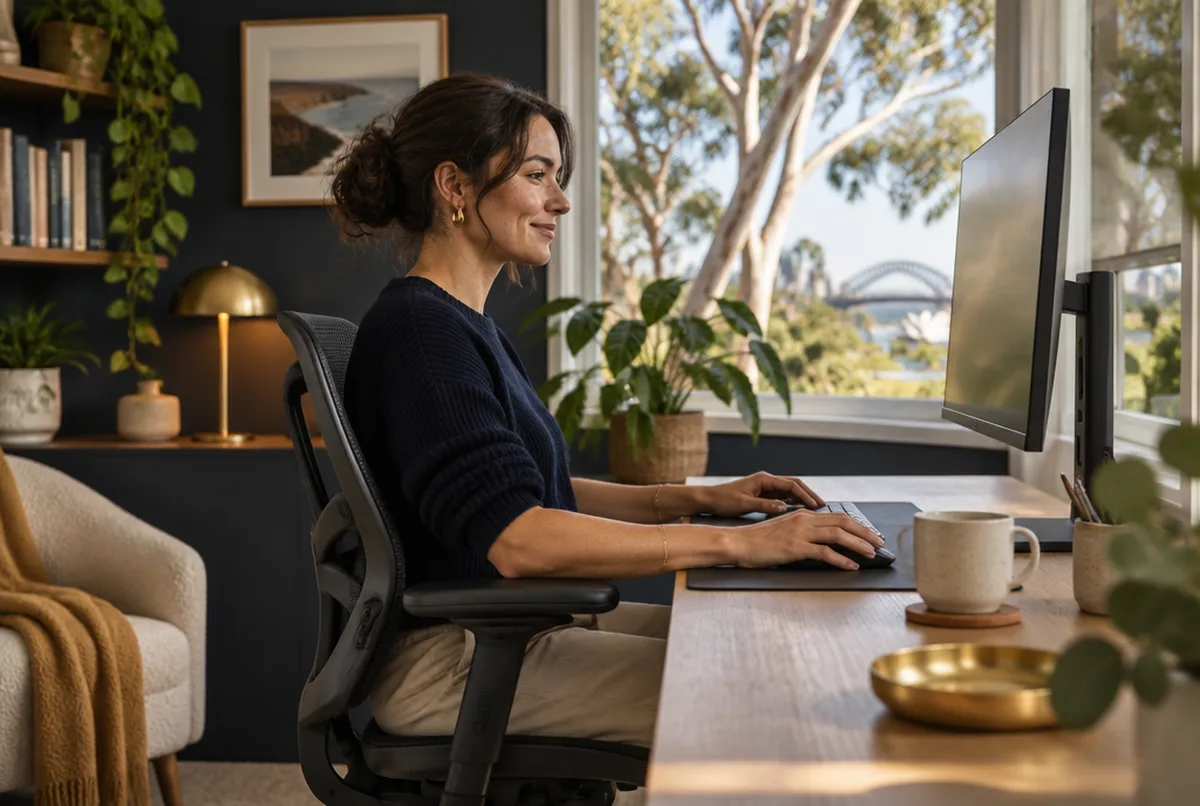
The checklist asks whether the work involves hazardous manual tasks such as repetitive movements or awkward postures, whether the workstation is safely and ergonomically set up, whether the worker has suitable equipment and whether that equipment is maintained. Safe Work Australia gives examples of fit for purpose equipment: headsets for frequent calls, adjustable chairs and monitors to avoid prolonged laptop use.
The environment section covers lighting and glare, ventilation and temperature, trip hazards, security, smoke detectors, access to first aid, drinking water and toilets, noise and power boards with a safety switch on the switchboard. Our short course on safe office and home based work covers workstation set up, eye strain and glare, and electrical and trip hazards in a home workspace. It is awareness training, not a workstation assessment.
Psychosocial risks of working from home
Regulation 55C of the model WHS Regulations requires PCBUs to manage psychosocial risks using the same risk management process that applies to other risks. Safe Work Australia lists psychosocial hazards that can come with home based work: high or low job demands, low job control, poor support, low role clarity and harmful behaviours such as online abuse, along with fatigue from long hours or being always on.
Practical controls from the PCBU information sheet include regular video catch ups, making sure managers have time to support remote staff, avoiding meetings outside ordinary hours, automatic replies on work phones and email after hours, and clear expectations that workers disengage at the end of the day. These line up with the right to disconnect in the Fair Work Act, which Fair Work says has applied to non-small business employers since 26/08/2024 and to small business employers since 26/08/2025. See our psychosocial hazards training for managers who lead hybrid teams.
Incident reporting and workers compensation when working from home
Make sure workers know how and when to report hazards, incidents and changes in their circumstances, and that they feel safe to do so. Safe Work Australia notes you must not discriminate against a worker, for example by dismissing them, for raising a WHS concern.
Notifiable incidents still apply at home. Section 38 of the model WHS Act requires the PCBU to notify the regulator immediately after becoming aware of a notifiable incident, and to keep a record of it for at least 5 years. On workers compensation, Safe Work Australia says workers will generally be covered while working from home if the arrangement is supported by the employer. In Queensland, for example, section 32 of the Workers' Compensation and Rehabilitation Act 2003 treats an injury as arising out of, or in the course of, employment if the employment is a significant contributing factor to the injury. Rules differ by state, so check with your insurer or regulator.
How WHS duties interact with flexible work requests
A request to work from home under the National Employment Standards is a separate process. Fair Work says employees with at least 12 months of service with the same employer can make a written request if, for example, they are the parent of, or care for, a child who is school aged or younger, are a carer, have a disability, are 55 or older, are pregnant, or are experiencing family and domestic violence. Casual employees also need regular and systematic work and a reasonable expectation that it will continue. You must respond in writing within 21 days, and you can only refuse on reasonable business grounds, after discussing the request, genuinely trying to reach agreement and considering the consequences of refusal for the employee.
Run both tests. A request may be reasonable under the Fair Work Act while a particular home set up still needs controls before it starts. Example: a payroll officer asks to work from home three days a week. The manager agrees in writing within 21 days, subject to a completed checklist, and offers a second monitor after the checklist shows the worker uses a laptop on a dining table. Our course on deciding flexible work requests lawfully covers the Fair Work side in detail.
What to record
- The signed checklist, with approval and review dates.
- Notes of consultation with the worker and any health and safety representative.
- Equipment provided and who maintains it.
- Agreed hours, breaks and after hours contact expectations.
- Training completed, with certificates kept on your team training register.
- Hazard and incident reports and what you did about them.
Training that covers this
These DueCourse courses are non-accredited short courses with a certificate of completion.
Frequently asked questions
Is my employer responsible for my safety when I work from home?
Yes. The employer's primary duty under WHS laws applies while you are working at home, so far as is reasonably practicable. You also have duties to take reasonable care, follow reasonable safety instructions and report changes that may affect your safety.
Can an employer refuse working from home for safety reasons?
Yes. Safe Work Australia says that if an employer cannot meet its WHS duties, it must not require or agree to working from home. It must then give the worker somewhere else safe to work, such as the office.
Am I covered by workers compensation if I am injured working from home?
Generally yes, if the arrangement is supported by your employer and the injury is connected to your work. The exact test depends on your state or territory scheme, so check with your employer's insurer or your workers compensation regulator.
Does the worker have to complete the working from home checklist?
The Safe Work Australia checklist is designed for the worker to complete and the PCBU to review and sign off. Workers are often the only people who know the risks in their home, which is why consultation is part of the duty.
Sources
- Safe Work Australia: Working from home, managing risks
- Safe Work Australia: Working from home PCBU information sheet (July 2023)
- Safe Work Australia: Working from home checklist (July 2023)
- Safe Work Australia: Incident notification
- Fair Work Ombudsman: Flexible working arrangements
- Fair Work Ombudsman: Right to disconnect
- Safe Work Australia: Model Work Health and Safety Act (as at 05/12/2025)
- Safe Work Australia: Model WHS Regulations (as at 05/12/2025)
- Safe Work Australia: Legislation (WHS laws in each jurisdiction)
- Queensland Legislation: Workers' Compensation and Rehabilitation Act 2003 (Qld)
Psychosocial hazards training for managers Keep a team training register Training for accounting practices with hybrid teams